The
The
Lightweight & Efficient Application Protocols (LEAP)
Manifesto
DRAFT ARTICLES
Using
Free Protocols & Free Software
to build the
Mobile & Wireless Applications Industry
Mohsen Banan
¡http://mohsen.banan.1.byname.net/ContactMe¿
August 27, 2001
Copyright ©2000-2001 Mohsen Banan
distribute verbatim copies of this document provided the copyright
notice and this permission notice are preserved on all copies.
Permission is granted to copy and distribute translations of this
document into another language, under the above conditions for
verbatim copying, except that this permission notice must be stated in
a translation approved by the Copyright holder.
Contents
1.1 The LEAP Manifesto – Draft Articles
2 LEAP on Palm OS
2.1 Introduction
2.1.1 LEAP on Open-Source PDAs
2.1.2 Palm OS Integration Strategy
2.2 Palm OS Mail User Agents
2.2.1 Separate Mail User Interface and Mail Transport Service
2.2.2 Integrated Mail User Interface and Mail Transport Service
2.3 Invitation to Participate
3 LEAP on Linux Based PDAs
3.1 Introduction
3.2 Integration Strategy for Open-Source PDAs
3.2.1 LEAP on Linux-Based PDAs
3.2.2 LEAP on eCos Based Phones and PDAs
3.3 Invitation to Participate
List of Figures
2.2 Example of Combined Mail Transfer Service for Palm OS
List of Tables
Chapter 1
About this Document
This document contains draft versions of articles intended for future inclusion in The LEAP Manifesto.
The LEAP Manifesto is a collection of articles which provide a comprehensive description of the LEAP protocols and their intended role in the development of the Mobile Messaging industry. Each article is largely self-contained, and can be read and understood independently of the others.
1.1 The LEAP Manifesto – Draft Articles
The LEAP Manifesto is a work in progress, and various additional articles are planned for future inclusion in the Manifesto. Some of these future articles already exist in draft form, and are provided in this document for preview by interested persons. At present, this document includes the following draft article:
- LEAP on Linux Based PDAs. A technical paper describing the architecture and implementation of LEAP on Linux Based PDAs.
This article is currently under development. As it and other articles are completed, they will be incorporated into the Manifesto.
The Draft Manifesto Articles are available in multiple formats, including HTML, PDF, PostScript, and plain text. You can view or download the drafts in any of these formats from the LEAP Forum website at http://www.leapforum.org/draft-leapManifesto/.
The latest version of the Manifesto is available on the LEAP Forum website at http://www.LeapForum.org/leap/index.html. The LEAP Manifesto is also available on the Free Protocols Foundation website at http://www.FreeProtocols.org/leap/index.html.
Chapter 2
LEAP on Palm OS
2.1 Introduction
This is one of a series of articles that describes the implementation and integration issues involved in incorporating the LEAP protocols into particular PDA environments.
The starting point for incorporation of LEAP in PDAs consists of the Mobile Messaging application, and is based on the Efficient Mail Submission and Delivery (EMSD) protocol [?]. EMSD is the e-mail component of the LEAP family of protocols [?].
A complete description of how EMSD provides everything necessary to enable end-users to benefit from true end-to-end open mobile messaging based on patent-free protocols and open source and free software is provided in the article Operation Whiteberry [?]. The present article is part of the more general Operation WhiteBerry model. Before reading this article, the reader is strongly encouraged to read Operation Whiteberry so that he/she has a clear understanding of the general implementation framework.
It is our goal to make LEAP widespread on all PDAs. However, the incorporation of LEAP into each platform follows a particular approach and strategy. Each of the articles in this series outlines our strategy for a specific platform.
Windows CE Integration Strategy
A standard mail application called Inbox is bundled with all Windows CE devices. Microsoft has defined a generic mail transport service provider interface underneath Inbox, which allows alternative mail submission and delivery protocols to be integrated with Inbox. Microsoft has also defined a winsock interface which provides access to UDP[?] and TCP[?] by third party applications. These well-defined APIs allow a new mail submission and delivery protocol to be integrated with Inbox in the Windows CE environment.
Our strategy for integration of EMSD in the Windows CE environment has been to provide a complete Mail Transport Service provider underneath Inbox. We have done so by providing EMSD binary distribution packages which end-users can quickly and easily plug in, allowing immediate implementation of the WhiteBerry model.
Additionally, the entire source code package for EMSD on Windows CE is available subject to the Gnu General Public License (GPL). The availability of this software package in source form allows tight integration with wireless modems, and other customizations/enhancements.
The existing open-source implementation is available at http://www.mailmeanywhere.org.
2.1.1 LEAP on Open-Source PDAs
It is highly desirable that there exist complete open-source and free software platforms as alternatives to the commercial PDA platforms such as Windows CE and Palm OS.
At the present time two such open-source platforms are “Linux Based PDAs” and “eCos.” Recently there have been numerous announcements of new Embedded Linux support for PDAs and other handheld personal computing devices. Various suitable eCos platforms are also now in place.
See the article LEAP on Linux PDAs [?] for more details.
2.1.2 Palm OS Integration Strategy
Palm OS is an effective, general purpose mobile computing platform which, among other applications, comes bundled with a simple e-mail application called Mail. In contrast to the Windows CE Inbox application, however, the standard Palm OS mail application has only a very rudimentary set of features and capabilities. Also in contrast to Windows CE, the Palm OS does not include a set of well defined APIs to facilitate the integration of alternative mail protocols.
To complicate matters further, various third party mail user agents have now become widely available for Palm OS (largely because of the limitations of the standard Palm OS mail application), with a variety of different user interfaces. Because of this multiplicity of incompatible Palm OS mail applications, each integration of LEAP with Palm OS must be specific to a particular Palm OS mail user agent.
For these reasons our strategy for integration of the EMSD protocol engine in the Palm OS environment is different from that for Windows CE.
We start with a very basic example implementation of EMSD for Palm OS. This example implementation is specific to the standard mail application, based on file access.
Based on the availability of this package in source form, subject to the Gnu General Public License, a variety of Palm mail user agents can become EMSD-enabled very rapidly. To accomodate this further we have selected certain mail user agents which we consider particularly desirable, and we will participate in the integration of EMSD with these mail user agents.
2.2 Palm OS Mail User Agents
There are two basic alternative approaches to developing an e-mail application in the Palm OS environment. These are:
- Separate Mail User Interface and Mail Transport Service
- Integrated Mail User Interface and Mail Transport Service
Our goal in this article is to accommodate incorporation of EMSD as a Mail Transport Service provider in both models.
2.2.1 Separate Mail User Interface and Mail Transport Service
In the separate mail user interface and mail transport service model, the application is split into two parts. One part is responsible for transferring the mail message, while the other part is responsible for processing and displaying the message.
An example of this approach is the standard Palm Mail application. The basic distribution of Palm OS lacks mail transport services such as SMTP[?], POP[?], or IMAP[?]. It normally depends on its desktop synchronization capabilities to accomplish the actual sending and receiving. Messages written by the user are put into a queue; then upon synchronization with the desktop, the desktop counterpart sends the queued messages and also retrieves received messages.
However there are add-on packages, such as Top Gun Postman [?] that provide SMTP and POP/IMAP support within the Palm OS device. This enables users of the standard Mail application to send and receive messages directly from their devices via a wireless modem.
Incorporation of EMSD into packages such as Top Gun Postman can be rapidly accomplished as an add-on or replacement for SMTP/POP/IMAP. Figure 2.1 shows the components involved as well as the layering of services in this model.
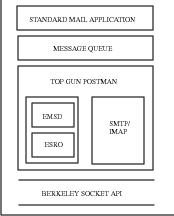
For example, the incorporation of EMSD support with Top Gun Postman can be very quick and easy because of the availaibility of EMSD protocol engines as a Palm OS library.
2.2.2 Integrated Mail User Interface and Mail Transport Service
In the integrated mail user interface and mail transport service model, the application is entirely self-contained.
There are numerous examples of this approach, since it offers greater convenience of operation and usage in the Palm OS environment. In particular MsgAgent [?] and DoodleMail [?] are very popular clients.
Figure 2.2 shows the components involved and the layering of services.
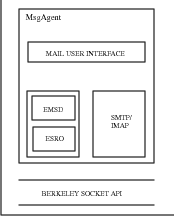
For example, the incorporation of EMSD support with MsgAgent can be very quick and easy because of the availaibility of EMSD protocol engines as a Palm OS library.
2.3 Invitation to Participate
As described in Operation WhiteBerry, the incorporation of EMSD in Palm OS mail packages presents enormous benefits.
We invite the developers of Palm OS mail application packages to incorporate EMSD into their software. EMSD protocol engines ready for the Palm OS environment are readily available, and can be easily integrated with your software. Complete implementations of EMSD in open-source form are available at http://www.mailmeanywhere.org.
Chapter 3
LEAP on Linux Based PDAs
3.1 Introduction
This is one of a series of articles that describes the implementation and integration issues involved in incorporating the LEAP protocols into particular PDA environments.
The starting point for incorporation of LEAP in PDAs consists of the Mobile Messaging application, and is based on the Efficient Mail Submission and Delivery (EMSD) protocol [?]. EMSD is the e-mail component of the LEAP family of protocols [?].
A complete description of how EMSD provides everything necessary to enable end-users to benefit from true end-to-end open mobile messaging based on patent-free protocols and open source and free software is provided in the article Operation Whiteberry [?]. The present article is part of the more general Operation WhiteBerry model. Before reading this article, the reader is strongly encouraged to read Operation Whiteberry so that he/she has a clear understanding of the general implementation framework.
It is our goal to make LEAP widespread on all PDAs. However, the incorporation of LEAP into each platform follows a particular approach and strategy. Each of the articles in this series outlines our strategy for a specific platform.
Windows CE Integration Strategy
A standard mail application called Inbox is bundled with all Windows CE devices. Microsoft has defined a generic mail transport service provider interface underneath Inbox, which allows alternative mail submission and delivery protocols to be integrated with Inbox. Microsoft has also defined a winsock interface which provides access to UDP[?] and TCP[?] by third party applications. These well-defined APIs allow a new mail submission and delivery protocol to be integrated with Inbox in the Windows CE environment.
Our strategy for integration of EMSD in the Windows CE environment has been to provide a complete Mail Transport Service provider underneath Inbox. We have done so by providing EMSD binary distribution packages which end-users can quickly and easily plug in, allowing immediate implementation of the WhiteBerry model.
Additionally, the entire source code package for EMSD on Windows CE is available subject to the Gnu General Public License (GPL). The availability of this software package in source form allows tight integration with wireless modems, and other customizations/enhancements.
The existing open-source implementation is available at http://www.mailmeanywhere.org.
See the article EMSD on Windows CE [?] for more details.
Palm OS Integration Strategy
Palm OS is an effective, general purpose mobile computing platform which, among other applications, comes bundled with a simple e-mail application called Mail. In contrast to the Windows CE Inbox application, however, the standard Palm OS mail application has only a very rudimentary set of features and capabilities. Also in contrast to Windows CE, the Palm OS does not include a set of well defined APIs to facilitate the integration of alternative mail protocols.
To complicate matters further, various third party mail user agents have now become widely available for Palm OS (largely because of the inadequacy of the standard Palm OS mail application), with a variety of different user interfaces. Because of this multiplicity of incompatible Palm OS mail applications, each integration of LEAP with Palm OS must be specific to a particular Palm OS mail user agent.
For these reasons our strategy for integration of the EMSD protocol engine in the Palm OS environment is different from that for Windows CE.
We start with a very basic example implementation of EMSD for Palm OS. This example implementation is specific to the standard mail application, based on file access.
Based on the availability of this package in source form, subject to the Gnu General Public License, a variety of Palm mail user agents can become EMSD-enabled very rapidly. To accomodate this further we have selected certain mail user agents which we consider particularly desirable, and we will participate in the integration of EMSD with these mail user agents.
See the article LEAP on Palm OS [?] for more details.
3.2 Integration Strategy for Open-Source PDAs
Reference implementations of the LEAP protocols are available as open-source and free software, subject to the Gnu General Public License (GPL).
It is highly desirable for there to exist useful and complete open-source and free software platforms as alternatives to the commercial PDA platforms such as Windows CE and Palm OS.
At the present time two such open-source platforms are of particular importance. These are:
- Linux-based PDAs
- eCOS
Our goal in this article is to accommodate the incorporation of the LEAP protocols, in particular EMSD as a Mail Transport Service provider, on both of the above platforms.
3.2.1 LEAP on Linux-Based PDAs
Recently there have been numerous announcements of new Embedded Linux support for PDAs and other handheld personal computing devices.
Such development efforts can benefit from efficient protocols which are specifically oriented towards the needs of miniaturized devices and mobile applications. As we have previously argued in the articles The WAP Trap [?] and WAP Scraps [?], the integration of pseudo-open protocols such as WAP with Embedded Linux is the wrong strategy. We are offering LEAP as an alternative [?].
Given the rapid emergence of Embedded Linux as a major “third alternative” to Palm OS and Microsoft Windows CE for handheld personal computing devices, we view the integration of LEAP with Embedded Linux as having special importance.
For a frequently updated overview of available and developing Linux-based PDA support, visit The Linux-PDA and PDA-Linux Quick Reference Guide at http://www.linuxdevices.com/articles/AT8728350077.html.
Because LEAP implementations on Linux and other Unix platforms are already in place, the incorporation of LEAP into Linux-based PDAs is simply a matter of portation.
The integration of EMSD as a Mail Transport Service provider with open-source Mail User Agents is often quite rapid. For example Pine, and GNUS and VM from Emacs, are major user agents for which EMSD integrations have already been completed.
The work of putting ESRO in kernel space, and providing a socket-based interface to ESRO, is currently in progress.
We consider the full and optimized integration of LEAP with Linux to be a strategic goal. We will continue to improve the quality of existing integrations, and the range of platforms for which LEAP and Linux support is provided.
3.2.2 LEAP on eCos Based Phones and PDAs
eCos is an open-source embedded operating system which is well in tune with the open-source and Linux software development framework. For more information (including source code), see http://sourceware.cygnus.com/ecos
Close integration of LEAP with eCos is highly desirable, because LEAP provides key applications that can greatly increase the utility and value of eCos. Note that on its own, eCos is just an operating system. But in combination with LEAP, eCos can provide Mobile Messaging and other powerful applications.
We intend to integrate LEAP with eCos in the context of a specific embedded hardware platform – specifically, the cell phone hardware platform. A cell phone platform running eCos and LEAP is extremely desirable.
If any such development effort is already underway, we would be pleased to hear about it. We will do all we can to cooperate in the creation of cell-phone-based open-source mobile applications and platforms. Please contact us at the e-mail address shown on the article title page.
3.3 Invitation to Participate
As described in Operation WhiteBerry, the incorporation of EMSD in open-source PDA platforms presents enormous benefits.
We invite the developers of open-source PDA platforms to incorporate EMSD into their software. EMSD protocol engines ready for the Linux environment are readily available, and can be easily integrated with your software. Complete implementations of EMSD in open-source form are available at http://www.mailmeanywhere.org.